
In my early days of learning tajweed, I was taught that before we truly learn to master how to recite the Quran Kareem correctly, we must first understand the rules that govern its sound. This blog is an optimal destination for anyone curious about Qalqalah, as it begins a spiritual journey to explore the details related to this important aspect of Tajweed.
To understand its meaning, we must define this key rule as one of the most fundamental, commonly applied concepts in Tajweed’s system, a concept you will continuously come across as you read and reflect. From a practical view, qalqalah—also known by its technical name قلقلة—is a straightforward and easy sound effect.
What is Qalqalah? – Short Answer
It is a slight echo or bounce that happens while pronouncing five specific Arabic letters: Qaaf, Taa, Baa, Jeem, and Daal. When these letters carry a Sukoon, a gentle vibration appears. This small change may seem minor, but it has a profound impact on how clearly the words are heard.
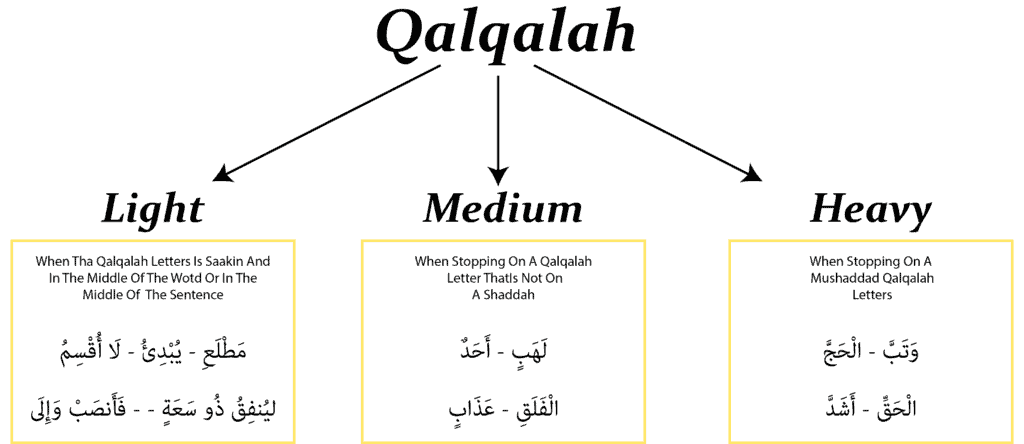
The sound varies by position and strength. In the middle of words, the sounds are softer, and this type is called Sughra. When stopping at word endings, the sound becomes stronger, known as Kubra. True mastery requires careful listening, regular practice, and expert guidance.
I have seen how this feature helps embellish recitation for Allah’s sake, turning a beautiful art of Quranic recitation into something more alive.
In the nature of the Quran, every letter has unique characteristics, and Qalqalah is a special, distinctive feature that adds a melodious touch. Once you understand how these different types look, you begin to understand the detail behind this important rule, and your recitation gains clarity, balance, and respect for the Quranic sound tradition.
What is the art of Tajweed?
When I first explored tajweed, I learned that it is derived from an Arabic root that means to beautify and bring beauty to recitation. This art does not only improve sound but also enhance eloquence and spirituality, making it an integral component of learning the Quran.
Through learning Tajweed, clear rules and guidelines teach correct pronunciation, proper pronouncing of each letter, and balance in Arabic letters, Arabic, rhythm, and intonation.
This creates clarity in recitation, whether you are a reciter or a person reciting the Quranic verses of the Holy Quran, helping the words and the words of Allah be delivered correctly and meaningfully within Islam. With time, I felt more connecting to the Quran, reciting beautifully as the sound immerses the heart into true discovery.
Tajweed brings depths of emotion, rhetorical subtleties, and full delivery, while offering cognitive benefits, stronger memory retention, and personal discipline, truly empowering the learner. It helps deepen one’s approach to recitation, and it is important to note that integrating Quran Online Classes can significantly improve the overall experience.
Many students ask, how can I learn quran with tajweed at home, and I often share that consistent practice helps maintain accuracy and confidence, allowing the soul to stay focused and spiritually present.
What is qalqalah in Tajweed?
Qalqalah is a significant concept in Tajweed and is characterized by a distinct echoing sound produced when certain Arabic letters are pronounced with sukoon, indicating no vowel.
Linguistically, its meaning is linked to designation and movement, for the sake of disturbance, which explains the core technique used to create a vibration. This kind of sound happens at the place of articulation of specific consonants, which are five, and when appearing, they give strong resonance to a word, in order make it clear and beautiful during recitation.
From years of listening and teaching, I have seen that these necessary features, once mastered by reciters, improve correct pronunciation and bring a melodious flow to the Holy Quran. This rule describes a slight bouncing or vibrating effect while pronouncing letters with Sukoon (سكون).
The subtle echo ensures the sound is heard clearly, instead of being swallowed or silent. The term قلقلۃ literally means disturbance, and in terminology, it refers to what occurs either when a letter is carrying a vowelless state or comes at the end where the reader stops.
This shaking sound translates perfectly into its technical application, where we disturb the point of articulation just enough to create a light echo. Now that we understand this concept, let’s meet the letters themselves through memorizing, which is the first practical step toward mastering this rule.
What Are the Letters of Qalqalah?
When learning Qalqalah in tajweed, it is essential to focus on the five letters that carry a distinct echoing sound in Quranic recitation. These consonants are part of the Arabic alphabet and are known as Huruful Qalqalah: Qaaf (ق), Taa (ط), Baa (ب), Jeem (ج), and Dal (د).
I’ve personally found that remembering them becomes much easier when using the memorable phrase “قطب جد” or the acronym “Qutbu Jadd,” as it naturally groups the letters in a simple, compiled way.
Each letter only produces the Qalqalah vibration in a sukoon or vowel-less state. The sound results from blocking the flow of air (Jahr) or blocking the flow of sound (Shiddah) while pronouncing them.
If a letter carries a vowel sign like Fatha, Kasra, Dhamma, or Tanween, the distinct echo-like sound usually does not appear. Scholars often stress practicing these letters in speech to master the specific characteristics of Qalqalah, and through consistent practice, the smooth pronouncing of Qutbu, Jadd, and the set of letters becomes second nature.
How to Identify Qalqalah Letters?
When learning tajweed, you,’ve probably noticed that some letters have a special echo that happens when you stop at the end of a verse. This sound occurs exactly on one of the five Qutbu Jadd, or قطبجد, letters when there is a Sukoon (ـْ) on it.
Sometimes the Sukoon is explicitly written, while other times it is implied and only occurs when the word is ending with a Qalqalah letter. I remember when I first found a Qalqalah letter; it took a bit of practice to find and recognize how the echo exactly happens, but once you train your ear, you,’ve mastered the key skill of identifying these letters naturally.
The main rules of qalqalah in Tajweed
Understanding Qalqalah in Tajweed has always fascinated me as a reciter. The letters that carry this special echo are five: ق (Qaf), ط (Taa), ب (Baa), ج (Jim), and د (Dal). These designated letters have a unique sound that can only be properly produced when the letter is in the correct state, either Sukoon or sukoon, meaning it is pronounced without any vowel markings like Fatha, Kasra, Dhamma, or Tanween.
Whether the Qalqalah letter appears in the middle of a word or at the end, the characteristic echoing must be applied correctly, and this makes the recitation clear and beautiful.
I have often noticed that even subtle differences in applying Qalqalah change the clarity, qualities, and overall beauty of recitation, which is why reciters must pay attention to understanding and applying these rules carefully.
Key Rules for Qalqalah
In my practice, the application of Qalqalah depends on precise situations where the letter needs a special release of sound. For example, when a Sakin Qalqalah letter appears in the middle of a word or phrase as a unit, with its original Sukoon, the sound can otherwise be trapped or muffled.
This produces what is known as Qalqalah Sughra, a gentle, lesser echo. Take the example of يَجْعَلُونَ (yaj’alūna), where the Jeem (ج) has a Sukoon in the middle. A light pronounce is required to make it clearly heard. On the other hand, when a Qalqalah letter appears at the end of a word while stopping, an incidental Sukoon is formed.
This happens when pausing the recitation to continue reading later, and the letter does not have its vowel like Fatha, Kasra, or Damma. In Arabic, this last silent letter triggers the Qalqalah Kubra, a strong echo. A perfect example is the first verse of Surah Al-Ikhlas, أَحَدٌ (ahadun), where we drop the tanween and damm to make the final Daal (د) pronounce with strength.
Through years of reciting, I realized that mastering these rules requires attention to every detail, understanding when the sound must be released, and applying the structure naturally. Whether it is a unit, original Sukoon, or newly formed silence, knowing how to handle it ensures the recitation conveys its unique qualities and the beauty of Qalqalah effectively.
Levels of Qalqalah
When learning Qalqalah, a reciter quickly notices that there are distinct levels that affect how clearly the echo is heard. From my experience, understanding these levels deeply improves recitation and adds precision to every letter you pronounce.
Strongest Qalqalah
The strongest Qalqalah is the most pronounced level of Qalqalah. It happens when a Qalqalah letter carries a Shaddah, producing a sharp, clear echo.
For example, in الْحَقُّ (Al-Haqq), meaning Truth, the letter Qaaf (ق) has a Shaddah, giving the strongest resonance. From my experience, mastering this level makes your recitation precise, powerful, and full of clarity, as every letter is carefully stopped and emphasized.
Strong Qalqalah
The strong Qalqalah occurs when you stop on a Qalqalah letter at the end of a word without a Shaddah. This is the common form most reciters encounter. For instance, in مُحِيطٌ (Muheet), meaning Encompassing, the letter Taa (ط) at the end produces a noticeable strong echo.
Practicing this taught me how subtle changes in stopping at the end of words can enhance the precision of every letter in your recitation.
Weak Qalqalah
The weak Qalqalah is the softest level and occurs when a Qalqalah letter appears in the middle of a word or phrase with a Sukoon. The echo is subtle, softer, and requires careful attention.
For example, in قبْل (qbl), meaning Before, the letter Baa (ب) is in the middle, producing a weak or lesser echo. Personally, practicing this made me realize the importance of control and awareness in recitation, as even the softest echo contributes to the beauty of Tajweed.
What are the types of qalqalah in tajweed?
Their are two types of Qalqalah:
- Qalqalah Kubra
- Qalqalah sughra (weak)
1. Qalqalah Kubra:
In my experience with Tajweed, the Qalqalah Kubra is a specific type of Qalqalah that occurs when a letter reaches the end of an ayah and is accompanied by a Shaddah. The last Harakah is dropped, and the letter is pronounced with a greater echoing sound, enhancing the reverberation and clarity of recitation.
This stronger form makes the letter prominent, adds aesthetic value, and strengthens the rhythm of the Quranic flow.
A distinct reciter stops at the word ending, where a pause gives the sound time to resonate, and this category includes strong Qalqalah that applies even when stopping without a Shaddah, as in the example of ‘ق’ in الْفَلَقِ, al−falaq, or the strongest form, Akbar, which is also requiring extra emphasis and powerful release, like in وَتَبَّ, watabb. Practicing this carefully enhances both understanding and the musicality of recitation.
2. Qalqalah sughra (weak):
When learning Tajweed, understanding Qalqalah Sughra can really improve your fluency and accuracy in reciting the Holy Quran. Unlike Qalqalah Kubra, which happens at the end of an ayah and is pronounced with a strong, echoing sound,
Qalqalah Sughra is a weaker, subtle vibration that occurs when a Qalqalah letter appears in the middle of a word with a sukoon, like the ‘ب’ in يَبْتَغُونَ or at the end of a word without a pause, as in قَدْأَفْلَحَ. The sound is minor, brief, and flows smoothly into the next letter, so the rhythm of the recitation is not interrupted.
Through practice, the lesser echo of Qalqalah Sughra becomes prominent yet less stressful than its stronger sibling, allowing for fine, controlled vibration with swiftness in transitioning to following letters.
Examples like يَجْعَلُ (Yaj’alu) and يَقْطَعُ (Yaq’ta’u) show how mastering this subtle skill makes reciting smoother and more accurate, reinforcing the importance of every letter and sound in Quranic reading. Even from my experience, focusing on one letter at a time and noting how it occurs with sukoon has made a huge difference in achieving fluency.
How to Learn, Recognize, and Memorise Them?
When you start learning Qalqalah, the first step is to focus on the key letters by using the acronym Qutbu Jadd (قطبجد). I found that constantly repeating it aloud helps your mind unlock the rule naturally.
Listening to the recitation of renowned Qaris like Sheikh Al-Hussary or Sheikh Ayman Suwayd sharpens your ear for the distinct bouncing sound of each letter. Pay close attention, carefully noting how the letters are pronounced in different verses, and try to listen repeatedly to catch the subtleties.
Next, practice is crucial. Read the letters aloud, record yourself, and compare your pronunciation with that of an expert reciter. A qualified teacher can pinpoint mistakes, guide you toward the correct articulation, and provide constructive feedback.
To properly execute Qalqalah, press each letter’s point firmly, create a slight bounce, and for Kubra, make it more pronounced while ensuring it doesn’t create an additional vowel. This method, repeating constantly and seeking guidance, has personally helped me internalize the letters and recall them accurately during recitation.
Some Qalqalah Examples from Quran
When I first started learning Tajweed, I found Qalqalah fascinating. It’s a unique rule in Quranic recitation where certain letters bounce slightly when pronounced, especially when stopping or in silence. There are two types to understand: Qalqalah Kubra and Qalqalah Sughra.
The Kubra occurs with a stronger bounce, usually at the end of a word, while Sughra happens subtly within a word or sentence. One way I practiced was by reading different verses and paying attention to the bounce.
For Qalqalah Sughra, try قُلْ, Qul, ل, أَحَد, Ahad; notice the subtle echo on ل. Similarly,
إِنَّكَ لَن تَسۡتَطِیعَ مَعِیَ (صَبۡرࣰا
سَأُنَبِّئُكَ بِتَأۡوِیلِ مَا لَمۡ تَسۡتَطِع عَّلَیۡهِ (صَبۡرًا
قَالَ ءَاتُونِیۤ أُفۡرِغۡ عَلَیۡهِ قِطۡرࣰا
وَإِن كُنتُمْ فِي رَيْبٍ مِّمَّا نَزَّلْنَا عَلَى عَبْدِنَا
demonstrate this gentle vibration beautifully.
For Qalqalah Kubra, I always focus on strong stops like in وَقَبْ, Waqab, ب, stopping or
تَبَّتْ يَدَا أَبِي لَهَبٍ وَتَبَّ
وَجَاءَتْ سَكْرَةُ الْمَوْتِ بِالْحَقِّ
بَلۡ كَذَّبُوا۟ بِٱلۡحَقِّ
وَٱلنَّخۡلَ بَاسِقَـٰتࣲ لَّهَا طَلۡعࣱ نَّضِیدࣱ
These verses hit harder when stopping, giving the recitation a musical resonance that I personally find deeply moving.
Sometimes, while reciting Ahad or Waqab, I notice that the bounce can make a difference in clarity, and stopping correctly on د or ب highlights the Qalqalah effect, which is why consistent practice matters. Through repeated reading, I’ve realized that combining Sughra and Kubra examples makes it easier to recognize patterns in other Surahs as well.
How to Practice Qalqalah and Other Tajweed Rules
When I first started learning tajweed, I realized the importance of understanding the basics before diving into advanced techniques. One rule that often challenges learners is qalqalah, which has different types and requires precise pronunciation of certain letters. Over time, I found that structured practice and guidance make all the difference.
Here’s how you can effectively practice qalqalah and other tajweed rules:
- Start with individual words containing Qalqalah letters. Focus on recognizing them clearly and understanding how each letter should be pronounced.
- Practice both Sughra and Kubra forms separately, as each has its unique strength and bounce in recitation.
- Record yourself regularly and compare with expert reciters. This helps identify mistakes early and adjust your speed, consistency, and clarity.
- Join an online course or community group to learn from a qualified teacher or sheik. The feedback from experienced guides is incredibly valuable for correcting mistakes.
- Extract ayat containing qalqalah and other rules like Non-sakinah, Meem sakinah, and Madd. Practicing with real examples improves retention and fluency.
- Focus on slow recitation first, gradually increasing speed while maintaining accuracy. The rhythm of letters and types of qalqalah should remain intact.
- Incorporate resources such as books, online platforms, or interactive exercises into your daily routine. Learning in different ways reinforces your understanding.
- Imitating the reciters you admire helps internalize correct articulation and subtle nuances of pronunciation.
- Maintain regularly scheduled practice sessions. Repetition builds muscle memory and ensures consistency in delivering strength and bounce for each qalqalah letter.
With time, patience, and structured guidance, mastering qalqalah becomes intuitive, and other tajweed rules start falling into place naturally.
Common Mistakes to Avoid
When I first started learning Qalqalah, I noticed many students struggle with a few key points. Here are the main mistakes to watch for:
- Adding a Vowel
- Turning the echo into a Fatha, Kasra, or Damma
- Changes the natural flow of recitation
- Example: pronouncing Ahad as Ahada
- Breaks the sound and vibration of the letter
- Being aware helps avoid errors
- Turning the echo into a Fatha, Kasra, or Damma
- Skipping the Qalqalah
- Some learners forget to apply the rule entirely
- Happens often when stopping at the end of a verse
- Makes the letter silent or unclear
- Emphasize that each letter must receive its right sound regardless of speed
- Some learners forget to apply the rule entirely
- Exaggerating the Echo
- Making the Qalqalah too forceful or explosive
- Should be clear, integrated, and natural
- Avoid creating an additional syllable or overdoing the sounds
- Right bounce comes from consistent practice
- Making the Qalqalah too forceful or explosive
- Inconsistent Application
- Applying Qalqalah in some places but neglecting it in others
- Every letter deserves attention, whether fast or slow
- Emphasize rules in every verse
- Applying Qalqalah in some places but neglecting it in others
By being aware of these common mistakes and practicing carefully, your recitation becomes smoother, the sound more precise, and your skill in Qalqalah stronger.
Makkah Quran Academy: best online platform for learning tajweed
At Makkah Quran Academy, students can enjoy a truly interactive online learning platform designed to improve Tajweed, Quran recitation, and the correct pronunciation and articulation of letters. From my personal experience, even as a beginner, the classes are structured to build confidence, skill, and a strong understanding of rules in a nurturing environment.
Instructors provide personalized guidance, using modern teaching methods that combine enjoyment with serious practice. Every participant can refine their abilities through dynamic, small class sessions, ensuring attention, feedback, and continuous improvement.
The academy offers a free trial session where a prospective student can take the initial step to a deeper understanding of Tajweed. The curriculum is all-rounded, covering Arabic phonetic techniques, Hafs from the style of Asim, and the spiritual essence of the Quran.
Through video-recorded lectures, practice exercises, tools, and materials, students gain the resources to enhance their study while enjoying a flexible scheduling, multilingual support, and competitive pricing. This top-notch, international education even issues a certificate of proficiency, allowing learners to draw closer, share knowledge, and truly unlock the secrets of Tajweed.
The program is affordable, fit for life schedules, and encourages refinement, enhancing skill, and a thorough mastery of Tajweed that combines techniques, practice, and personalized feedback into a truly supportive learning journey.
Conclusion
From my experience in learning Qalqalah, I’ve realized that mastering this rule is truly essential for a proper Quranic recitation. Every aspect of Tajweed requires consistent practice, careful attention to detail, and dedicated learning under a qualified teacher.
When you apply yourself fully, your overall recitation improves, and you can perfect the nuances of Qalqalah. With sincerity, may Allah accept your efforts in implementing the rules of His Book, making every session meaningful and spiritually rewarding.
FAQ’s
How many levels of Qalqalah are there?
In tajweed, I learned early from scholars that the bouncing sound of Qalqalah has three clear levels, which depends on where the letter occurs and whether it is stressed or not, a point teachers often explain by comparing how Baa ب stays distinct from Meem م when reciting;
From my own practice, listening closely to this contrast helped me feel how the rule works naturally rather than mechanically, especially when focusing on control and clarity in real recitation.
What are the 5 Qalqalah letters?
In tajweed, Qalqalah is a special echoing sound, and from my own teaching experience, students learn it faster when they focus only on the five letters. These letters are Qaaf (ق), Taa (ط), Baa (ب), Jeem (ج), and Daal (د), all known together through the word and phrase Qutbu Jadd (قطبجد).
This grouping is easily remembered because it makes memorizing smoother and easier, especially for beginners who struggle with pronunciation. When I guide learners, I always remind them that mastering these five sounds builds confidence and clarity in recitation.
What is the meaning of Qalqalah in Urdu?
From my own experience of teaching Quran recitation, I explain that Qalqalah is an Arabic word that means a slight vibration or echo in the sound when saying certain letters during recitation; in simple Urdu terms, it refers to giving a special bounce to a letter so it does not sound flat, which helps the Quran stay clear and correct as it was revealed.
What are the 4 rules of Tajweed?
Before fully understanding Qalqalah, it is important to know the four core rules of Tajweed that guide correct pronunciation in the Quran, especially for Noon Sakinah (نْ) and Tanween (ــًــٍــٌ): Izhar for clear sound, Idgham for merging, Iqlab for conversion into meem, and Ikhfa for concealment with nasalization;
From my own learning experience, I saw how these rules, based on the following letter, work alongside Ghunnah, Madd, and letter characteristics to ensure a smooth, melodic flow while reciting and help learners pronounce each sound correctly.
What is the rule of Qalqalah?
When reciting the Quran, I always pay close attention to the letter that has sukoon, meaning it is saakin, because it is here that the beauty of Qalqalah shines. The rule is to lightly disturb the sound without any unnecessary movement of the mouth, producing a turbulent, yet controlled vibration that gives a clear, distincttone.
From my experience, when done correctly, the sound can be clearly heard, and it perfectly matches the corresponding pronunciation rules, making the recitation melodious and precise. Mastering this small nuance adds a rich layer of depth to every verse, and noticing the tiny movement in the mouth while keeping the letter stable helps maintain the sacred rhythm of the words.