
When we start discussing Types of Madd in Tajweed, we are not just studying theory; we are entering one of the most captivating topics in the vast world of Tajweed. From my own experience teaching both beginners and advanced learners,
I have seen how understanding the classification of Madd ( مَدّ ) changes a student’s recitation completely. The word literally means stretching or lengthening, and it translates to stretch and lengthen a vowel sound in specific situations.
This elongation rule is one of the most important and fundamental concepts within the intricate rules and basic tajweed rules that govern the correct pronunciation of letters and words in the Arabic language. In simple terms, Madd is the art of controlled elongation of certain vowel sounds.
It is not arbitrary; rather, it is carefully designed within the science of proper, Qur’anic pronunciation. When Reciting the Qur’an, this precise act requires full adherence to these rules, because each sound and pause must be executed with precision.
This system ensures that the sounds are stretched appropriately, maintaining the verses’ rhythm, beauty, and meaning, while preserving the integrity and preserving purity of the divine text as it was revealed to Prophet Muhammad, peace be upon him.
As I often tell my students in every blog post or article I write to explore this concept in detail, mastering Tajweed is essential if you want to recite the Holy Quran with accuracy, aesthetic appeal, and in line with the Sunnah.
The application of various types of Madd, supported with clear examples and detailed explanation, helps to enhance the listener’s experience. It creates a melodic rhythm, a profound sense of awe, and allows the reciter to breathe life into the divine verses.
This transforms a simple reading into a deeply moving, spiritually enriching experience, building a strong spiritual connection that transcends language barriers for Muslims around the world.
To truly unlock the profound beauty, guidance, and wisdom within this divine masterpiece, one must delve into the linguistic and phonetic structure of Arabic. This journey into the heart of Quranic aesthetics helps you refine, improve, and make better your Quranic recitation, helping you connect deeply with the message.
Through understanding and mastering these fundamental principles, the vital role of Madd becomes clear: It helps elevate recitation into an act of worship that reflects the true divine nature of the revelation.
What Are the Madd Letters?
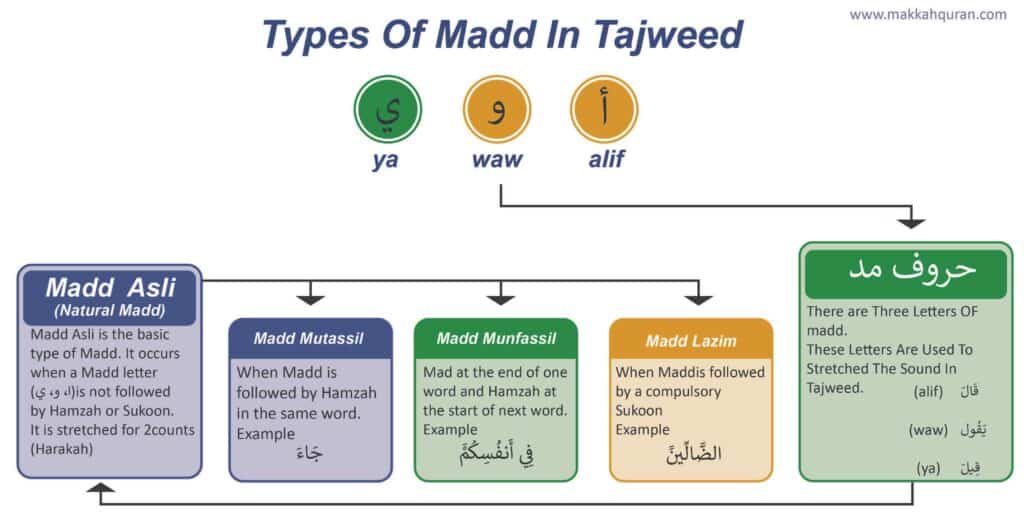
Before we dive into the different and various types of Madd, it is important to first understand the three fundamental letters known as حروف المد. These Letters of Madd, also called Huroof al−Madd, form the basis of all rules related to elongation in Arabic recitation.
From my own teaching experience, I have seen that when students truly grasp these letters, everything else becomes easier and more natural in pronunciation. These three letters play a crucial role in elongating sounds correctly.
They must be in a sakin state, meaning they are silent and come without their own vowel for the elongation to occur effectively. The first is Alif (ا). This letter occurs when it is preceded by a Fathah (ــَ or Fatha ـَ). A common example can be seen in the word قَالَ (qāla).
Here, the alif serves to extend the vowel sound. When teaching beginners, I often ask them to slow down and clearly feel the stretch in that single long vowel. The second is Waw (و). It appears when preceded by a Dammah (ــُ). An instance of this is the word يَقُولُ (yaqūlu).
In this case, the waw allows the elongation that follows the rounded vowel sound. When students practice this repeatedly, they start noticing the smooth flow created by this extension. The third is Ya (ي). It is used when preceded by a Kasrah (ــِ). You can observe this in the word فِي (fī).
The ya contributes to the lengthening of the vowel in a very gentle way. I always remind learners to listen carefully to the clarity of that long “ee” sound. Whenever these three letters appear in a word with their specific preceding vowel, they trigger elongation. The duration of this stretch is measured in harakah or vowel counts.
A harakah is the amount of time it takes to say a single short vowel. This measurement is what differentiates the various forms of Madd. By focusing on how each letter connects to its vowel and by practicing slowly, learners begin to feel the rhythm rather than just memorizing technical details.
That practical awareness makes the journey into the remaining types of Madd much smoother.
The Two Main Categories of Madd
Madd Asli, مَدّ أصلي
Now, when we return to Madd Asli, مَدّ أصلي, also known as Natural Madd, Madd Tabee’ee, The Natural Madd, or even Original Madd, we see the natural elongation that is always present when one of the three Madd letters exists.
This is the basic elongation, occurring naturally, without specific cause, meaning no Hamzah, ء, or Sukoon, ْ, is following it. It is prolonged for two counts, exactly two Harakat, sometimes described as 2 Harakat, which are short counts, approximately the time to say “one-two.” If we remove this stretch, the meaning changes or becomes incorrect.
The Madd Letters are clearly defined: Alif, ا, Preceded by a Fatha like قال or قَالَ (qāla) where the ‘a’ sound in qa is stretched; Waw, و, Preceded by a Dhamma like يقول or يَقُولُ (yaqūlu) where the ‘u’ sound in qū is stretched; and Ya, ي, Preceded by a Kasra like قيل or فِي (fī) where the ‘i’ sound is clear.
The Elongation here follows simple Rules with no specific conditions attached. It is inherent, simple, and foundational before moving to the extended elongation found in other forms.
Madd Far’i, مَدّ فرعي
In Tajweed, Madd is broadly categorized into two types, and I often like to begin teaching with the second one because it shows how rules grow from the basic foundation. Madd Far’i, مَدّ فرعي, also called Secondary Madd, is a type that occurs due to a specific reason, not just naturally.
By Definition, it is an extended elongation that happens when a Madd letter is followed by a Hamzah, Hamza, ء, or a Sukoon, ْ. This means the sound is stretched for more than two counts, depending on its specific type and recitation style.
From my experience in teaching, students clearly notice the beauty of this elongation when they carefully elongate the sound according to the Rule. There are important subcategories under this. In Madd caused by a Hamza, we find Madd Muttasil or Connected Madd,
Where the Madd letter is directly followed by a Hamza in the same word, such as جاء, and it is stretched for 4–5 Harakat. Here, the Rule is Obligatory. Then we have Madd Munfasil or Separated Madd, where the Madd letter appears at the end of one word and is followed at the beginning of the next word, like إنا أعطيناك;
This is Permissible, not obligatory, but still stretched for 4–5 Harakat. In Madd caused by a Sukoon, we see Madd Laazim, the Necessary Madd, where a permanent Sukoon comes after the Madd letter in the same word, such as الضالين, and it is extended to 6 Harakat.
Another form is Madd Aarid lil Sukoon, the Temporary Madd, where a temporary Sukoon appears because of stopping in recitation, like at the last word العالمين, and it may be read with 2, 4, 6 Harakat, based on style. These are examples of greater elongation caused by clear external causes and specific factors like hamzah and sukoon.
10 Types of Madd Far’i
1. Madd Wajib Muttasil (مَدّ واجب متصل) – Obligatory Connected Madd
In Tajweed, one of the key techniques is Madd when a letter is immediately followed by Hamzah in the same word. This type of Madd must be prolonged for 4 or 5 counts, and noticing how it works with each letter can make your recitation smoother and more precise.
For example, Alif followed by Hamzah, as in جَاءَ (jā’a), requires holding the ā sound for the correct counts. Similarly, Waw followed by Hamzah, like سُوءٌ (sū’un), or Ya followed by Hamzah, as in سِيءَتْ (sī’at), needs careful elongation of the ū and ī sounds.
Paying attention to the components like jā’a, sū,un, sī,at in each word helps internalize the rhythm and makes Madd with Hamzah intuitive. Over time, practicing these patterns transforms tricky recitation into smooth, flowing Tajweed.
Examples
Alif + Hamzah: جَاءَ (jā’a) – hold ā for 4 or 5 counts
Waw + Hamzah: سُوءٌ (sū’un) – hold ū for 4 or 5 counts
Ya + Hamzah: سِيءَتْ (sī’at) – hold ī for 4 or 5 counts
2. Madd Ja’iz Munfasil (مَدّ جائز منفصل) – Permissible Separated Madd
When learning Madd, one thing I always notice is how important it is to spot the letter at the end of a word and the Hamzah at the beginning of the next word.
This type of Madd is permissible because reciters have the option to either prolong it for 4 or 5 counts or shorten it to 2 counts, depending on the recitations they follow. Personally, while practicing with Hafs ‘an ‘Asim, I found that understanding when to prefer the longer or shorter prolonged Madd makes the recitation smoother and more meaningful.
For instance, in examples like بِمَا أُنزِلَ (bimā unzila), the Alif at the end of bimā is followed by the Hamzah at the start of unzila.
Similarly, قَالُوا آمَنَّا (qālū āmannā) has a Waw at the end of qālū followed by Hamzah at the start of āmannā,
and فِي أَنْفُسِكُمْ (fī anfusikum) shows the Ya at the end of fī followed by Hamzah at the start of anfusikum.
Observing these patterns carefully helps a reciter stay precise, while still enjoying the flexibility of this permissible Madd.
3. Madd Badal (مَدّ بَدَل) – Substitute Madd
When I first learned Tajweed, I realized that Hamzah can completely change how a Madd letter behaves in a word. In Madd Badal, one Hamzah is replaced by a Madd letter, which makes the recitation smoother.
This type of substitution happens when there are two Hamzah: the first has a vowel, and the second has a sukoon. The second Hamzah is then replaced by a letter that matches the vowel of the first. This Madd is prolonged for 2 counts, helping maintain proper rhythm and melody in recitation.
Here are the examples explained:
- آمَنُوا (āmanū) – Originally أأمنوا. Here, the second Hamzah with sukoon is replaced by Alif, which matches the vowel of the first Hamzah. This allows the sound to prolong naturally for 2 counts.
- إِيمَانًا (īmānan) – Originally إئمانًا. The second Hamzah with sukoon is replaced by Ya, creating a smooth transition and prolonged sound for 2 counts, keeping the vowel consistent.
- أُوتُوا (ūtū) – Originally أؤتوا. In this case, the second Hamzah is replaced by Waw, matching the vowel of the first Hamzah, and the Madd is prolonged for 2 counts, which ensures the recitation flows melodiously.
From my experience, noticing how the second Hamzah is replaced makes a huge difference. It helps not only in proper substitution but also in keeping the vowel harmony and correct prolonged timing, which are essential for Tajweed mastery.
4. Madd Silah (مَدّ صلة) – Connecting Madd
This type of Madd is used only for the pronoun “Ha” (ـهُ / ـهِ) when it comes between two vowel sounds.
5. Madd Silah Sughra (صِلة صُغرى) – Lesser Connecting Madd
In the study of 10 Types of Madd Far’i, after understanding the first topic, we move to a softer and more subtle rule called Madd Silah Sughra (صِلة صُغرى). This rule focuses on the pronoun Ha (ـهُ, ـهِ) when it comes between two vowels and no Hamzah follows it.
In this case, the sound is prolonged for 2 counts, not more and not less. From my own teaching experience, many learners overlook this light extension, but once they notice the small sign written to indicate the Madd, it becomes simple.
A small Waw (و) or a small Ya (ي) appears after the hu or hi, helping in forming a smooth Waw sound or Ya sound while keeping the recitation natural and flowing. The important point is that the Ha must stay connected and clearly elongated without exaggeration.
Examples with explanation:
In إِنَّهُ كَان (innahu kāna), the hu at the end of innahu is the pronoun Ha (ـهُ). It comes between two vowels, and since there is no Hamzah after it, we stretch it for 2 counts. Here, a small Waw (و) is understood, gently creating a soft Waw sound.
In عِبَادِهِ خَبِيرًا (ʿibādihi khabīrā), the hi is the pronoun Ha (ـهِ). Again, it is between two vowels and not followed by a Hamzah, so it is prolonged for 2 counts. In this case, a small Ya (ي) helps in forming a light Ya sound, making the connection smooth and clear.
6. Madd Silah Kubra (صِلة كُبرى) – Greater Connecting Madd
In Madd Silah Kubra (صِلة كُبرى) – Greater Connecting Madd, the rule applies when the pronoun Ha (ــهُ / ــهِ) comes between two vowels and a Hamzah follows it; in this case, the sound is prolonged for 4 or 5 counts, and it is similar to Madd Munfasil in strength and timing.
From my own teaching experience, students often miss this because they read the hu or hi quickly, but here it must be clearly elongated: if the vowel with هُ appears, it stretches with a Waw sound, and if it is هِ, it stretches with a Ya sound, making the recitation smooth yet powerful in this Greater Connecting Kubra style of صِلة كُبرى.
Examples:
مَالَهُ أَخْلَدَه (māluhu akhladahu) – Here the hu in مَالَهُ is elongated into a Waw sound because a Hamzah in أَخْلَدَه comes right after it, so it is read with 4 or 5 counts.
بِهِ أَذًى (bihi adhā) – In this case, the hi in بِهِ is followed by a Hamzah in أَذًى, so it stretches with a Ya sound for 4 or 5 counts, showing the clear rule of Madd Silah Kubra.
7. Madd Far’i due to Sukoon
These kinds of Madd happen when a Madd letter is followed by a Sukoon.
8. Madd Arid Lil Sukoon (مَدّ عارض للسكون) – Temporary Madd for Sukoon
Madd ‘Āriḍ li as-Sukūn is a special kind of Madd that happens when a letter is followed by a temporary Sukoon because of stopping the recitation at the end of a word. In simple terms, when you pause, the sound naturally becomes prolonged, and you can stretch it for 2, 4, or 6 counts.
These three lengths are all permissible, but from my experience teaching Tajweed, consistency is the key—once you choose a length in your recitation, try to keep it the same so your flow remains smooth and controlled.
Examples:
الْعَالَمِينَ (al-‘ālamīn) – When you stop on this word, the ‘īn’ sound becomes stretched because of the temporary Sukoon.
نَسْتَعِينُ (nastaʿīn) – If you stop here, the ‘īn’ is also stretched, and you may hold it for 2, 4, or 6 counts depending on your chosen pace.
9. Madd Lin (مَدّ لين) – Soft Madd
Building on Madd Arid Lil Sukoon, Madd Lin is another type of soft letters extension that I personally found fascinating when I first learned Tajweed.
It occurs when a Waw Saakin (وْ) or Ya Saakin (يْ) is preceded by a Fathah and followed by a temporary Sukoon, which means the recitation stopping creates a gentle elongation. These are not true Madd letters because they are not preceded by their corresponding vowel like Dammah for Waw or Kasrah for Ya.
In practice, the sound can be prolonged for 2, 4, or 6 counts when stopping, while if you continue reciting, it is pronounced normally without elongation.
Examples:
خَوْفٍ (khawf) – here, when you stop, the ‘aw’ sound is stretched, giving the recitation a soft, gentle pause.
Another instance is بَيْتٍ (bayt), where the ‘ay’ sound is stretched if you stop at the end. These subtle elongations make the recitation smooth and melodious, adding a unique rhythm to the Qur’an.
10. Madd Lazim (مَدّ لازم) – Compulsory Madd
When I first studied Madd, I noticed that some letters are always followed by a permanent Sukoon or Shaddah, which is really indicating that the letter is doubled and must be held longer.
This is the strongest type of Madd, and it often appears at the beginning of certain Surahs or within the same word, making it crucial to prolong it for exactly 6 counts.
Practicing this repeatedly helped me understand how a permanent sukoon changes the rhythm of recitation, ensuring clarity and fluency while maintaining the proper rules. Over time, I realized that focusing on each letter, its doubled nature, and the prolonged timing makes the recitation more impactful and spiritually satisfying.
Types of Madd Lazim
Kalimi Mukhaffaf – Light Word Madd
Kalimi Mukhaffaf is a Light Word Madd where the Madd letter is followed by a Sukoon instead of a Shaddah, giving a gentle elongation in the same word. This occurs only in two places in the Quran, specifically in Surah Yunus. From my experience, this Madd is easier to manage but requires careful attention to avoid overextending.
Example:
الْآنَ (al-āna) – The Alif is followed by a Sukoon.
Kalimi Muthaqqal – Heavy Word Madd
Kalimi Muthaqqal, or Heavy Word Madd, involves extending the Madd letter with a Shaddah in the same word, making it more prominent and powerful. Mastering this Madd helps create emphasis and flow in recitation, and it demands controlled elongation.
Examples:
الضَّالِّينَ (ad-dāllīn) – The Alif is followed by a Shaddah
الْحَاقَّةُ (al-ḥāqqah) – The Alif is followed by a Shaddah
Harfi Mukhaffaf – Light Letter Madd
Harfi Mukhaffaf is a Light Letter Madd that appears at the beginning of isolated letters in certain Surahs. The Madd letter is followed by an unmerged Sukoon, creating a smooth and soft sound. Practicing this Madd brings clarity to recitation without adding unnecessary heaviness.
Example:
صۤ (Sād) – The Madd is followed by an unmerged Sukoon.
Harfi Muthaqqal – Heavy Letter Madd
Harfi Muthaqqal is a Heavy Letter Madd found at the beginning of certain isolated letters in Surahs, where the Madd letter is followed by a merged letter or Shaddah. It produces a strong, resonant sound that requires deliberate control and focus.
Example:
الۤمۤ (Alif-Lām-Mīm) – The Lām involves a Madd followed by the merged Mīm.
Madd Al-Farq – Differentiating Madd
Madd Al-Farq, or Differentiating Madd, distinguishes between a questioning Hamzah and an assertive Hamzah. Here, أَ precedes a Madd Lazim Kalimi, and the extension can be prolonged for 6 counts. Understanding this Madd adds meaning and precision to recitation.
Examples:
ءَآللَّهُ (aallāhu) – “Is it Allah?” – Occurs when a questioning Hamzah comes before Allah
ءَآلذَّكَرَيْنِ (aadh-dhakarayni) – “Are they the two males?” – Shows the distinction in questioning context.
How Do You Read Madd Letters?
1. Reading Madd Letters Correctly
When learning Tajweed, one of the first lessons I focus on is understanding how Madd letters work. These letters,
Alif (ا), Waw (و), and Ya (ي),
Are known as Madd Asli or Natural Madd, and they must be elongated for 2 Harakat to maintain proper recitation. Each letter is Always preceded by a specific vowel: Fatha comes before Alif, so when you read Qaala (قال), you gently stretch the sound.
Similarly, Dhamma precedes Waw, making Yaqool (يقول) flow smoothly, and Kasra comes before Ya, as in Qeela (قيل). Paying attention to how these vowels interact with letters is essential, and practicing with example words repeatedly helps make the rhythm natural.
Over time, reading these letters correctly becomes instinctive, and you feel the melody of the Qur’an as it was meant to be recited.
2. Elongation Timing
When reading Madd letters, the length is carefully measured in Harakat, which are the beats or counts that guide your recitation. Each Haraka represents a small time interval, roughly the moment it takes to open or close a finger naturally.
For example, holding a sound for 2 Harakat creates a Slight elongation, while stretching it for 4 Harakat results in a Moderate elongation, and 6 Harakat gives a Long elongation. Practicing this rhythm has personally helped me feel the flow of the Qur’an and maintain consistency without rushing, making the recitation smooth and spiritually connected.
3. Practice Proper Pronunciation
From my experience, the key to mastering Madd’s letters is to slow down, Pause, and read each Madd letter correctly by giving it the correct duration; when you elongate with control and follow the prescribed number of Harakat, you naturally Avoid rushing or over-extending the sound beyond its limit, which keeps your recitation smooth and accurate.
Example
In قال, Elongate the “aa” sound for 2 Harakat and pronounce it as Qaa-la; in جاء, hold the “aa” sound for 4–5 Harakat and read it as Jaa’-a; and in الضالين, Stretch the “aa” sound for 6 Harakat, saying Adh-Dhaa-lleen.
5. Listen to Expert Reciters
When I first struggled with Madd, I realized that simply reading about rules was not enough; I needed Hearing skilled Qaris and reciters who could clearly demonstrate how proper elongation and rhythm should sound.
Listening to famous Reciters like Sheikh Sudais, Sheikh Shuraim, and Mishary Rashid Alafasy helped me match their tone and pace because they strongly emphasize Madd rules in their beautiful recitations. This habit did more than improve my sound; it began to enhance my understanding and truly help me feel the flow of each verse.
If you are serious about growth, I always give recommendations for reliable Tajweed resources and even simple daily recipes for practicing Madd, because steady listening and repetition make these rules natural rather than forced.
Why Mastering the Types of Madd Truly Matters
When I began Learning Tajweed, I thought Mastering the different types of Madd was only a technical exercise. Over time, I realized it is deeply spiritual, rooted in respecting the divine text and reciting it as it was revealed. Among the key reasons this skill is so crucial is Preserving the Meaning.
Even Altering the length of a sound can sometimes change a word, so Reciting with the correct stretch ensures the intended message is conveyed accurately. This careful approach protects the message of the Quran and keeps its message pure.
At the same time, Madd plays a big role in Enhancing the Beauty of Recitation. It adds musicality and flow, making the sound more beautiful, engaging, and powerful. It allows the reciter to express awe and reverence for the divine words.
It is also about Connecting to the Sunnah, as the rules of Tajweed, including Madd, were passed through generations from Prophet Muhammad, peace be upon him. By applying and following these teachings, we honor that tradition while also Improving Memory.
The rhythmic nature of proper recitation, with its specific elongations and pauses, greatly helps in memorizing and strengthens both heart and mind.
Start Your Journey with Makkah Quran Academy for Types of Madd in Tajweed
If you are a complete beginner or someone looking to refine your Tajweed skills, Makkah Quran Academy offers a wide range of online Tajweed courses that are tailored to your needs.
From my personal experience, having dedicated instructors who provide one-on-one guidance and personalized feedback makes all the difference in understanding the science of Tajweed.
The supportive learning environment at the academy helps you master the rules of Madd effectively, allowing you to apply them with confidence and ease during your Quran Recitation. Every session is designed to make learningenjoyable and a truly rewarding experience.